The wastewater network is becoming increasingly intelligent. United Utilities is currently rolling out 330 intelligent wastewater pumping systems across north-west England as part of its programme to reduce storm-overflow spills.
The technology can adapt automatically to changing operating conditions, help prevent clogging and provide monitoring information that can reduce unplanned maintenance and engineer call-outs.
Elsewhere, water companies are investing in condition monitoring, sensors and predictive technology designed to identify problems before assets fail. This represents a significant change for the drainage industry. Historically, many problems have only become apparent when something happens.
- A sewer blocks.
- A pump fails.
- A rising main bursts.
- A property floods.
- Someone phones.
- An engineer is dispatched.
Increasingly, the infrastructure itself will be able to tell us that something is wrong. But that creates another question: What happens next?
Detecting a problem isn’t the same as fixing it
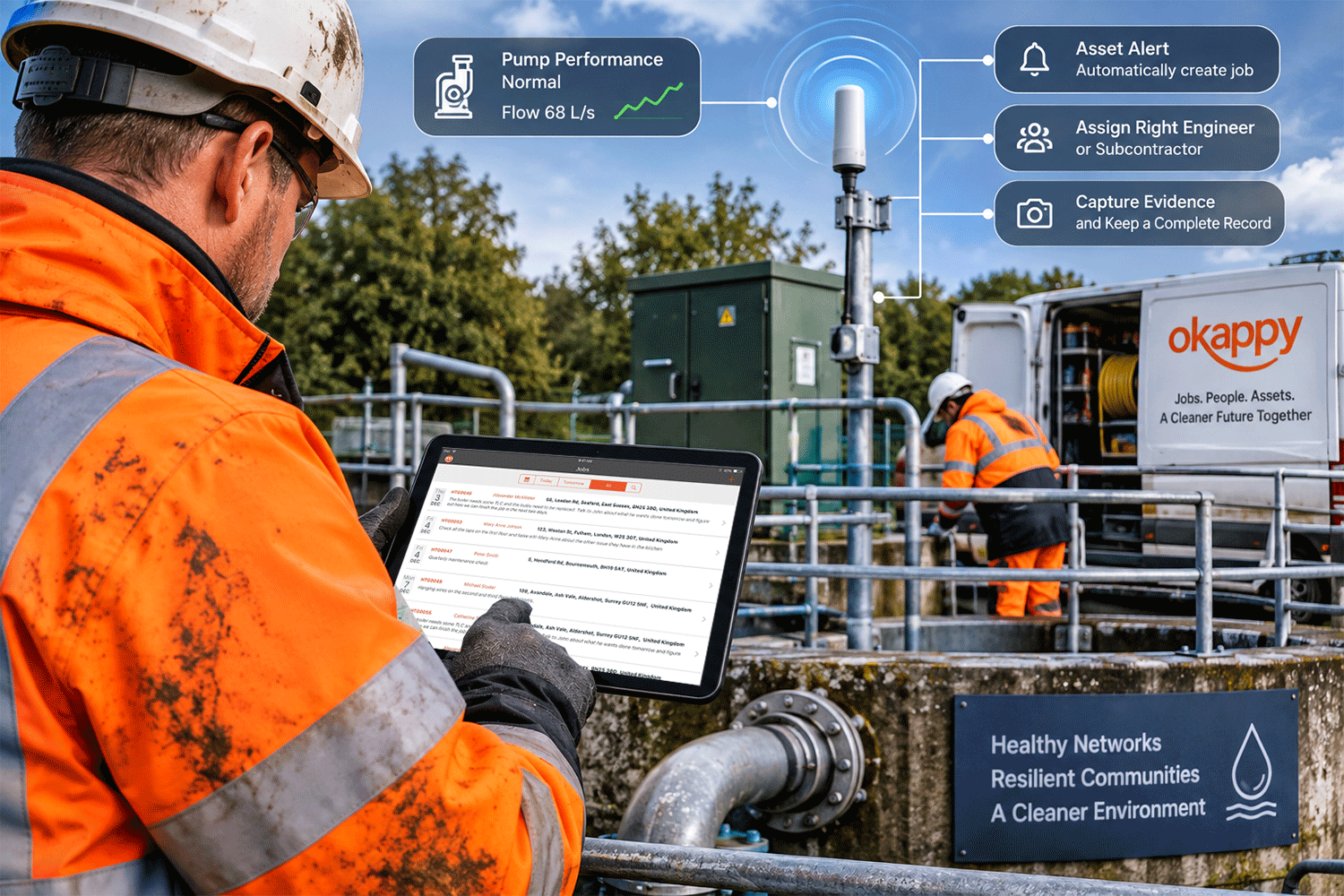
Consider a wastewater pumping station. Sensors identify an unusual change in pump performance. The monitoring platform determines that the equipment may be developing a fault. An alert is generated.
That is valuable information. But unless something happens as a result, the underlying operational risk remains.
Someone needs to determine how urgent the problem is. A job may need to be raised. An engineer or specialist contractor needs to be identified. They need the correct asset and fault information. The work needs scheduling. The engineer needs to attend. Their findings need recording. If further work is required, somebody needs to ensure that happens too.
The real opportunity therefore isn’t simply smart infrastructure. It is connecting smart infrastructure to operational workflows.
The wastewater network is becoming more connected
The United Utilities project is part of a much wider trend. Utilities are increasingly deploying monitoring technologies across pumps, treatment works, rising mains, sewers and storm overflows. Some systems monitor flow. Others monitor vibration, electrical signals, pressure or equipment performance.
Increasingly, artificial intelligence can analyse this information to identify patterns that might indicate a developing problem.
This is particularly valuable for assets that are difficult to inspect.
Rising mains are a good example. Unlike gravity sewers, these pressurised pipelines can fail without immediately providing an obvious indication of what has happened. New monitoring technology developed with Yorkshire Water and Southern Water is intended to detect these failures earlier. That matters because every additional hour before a burst is detected potentially increases the environmental damage and cost of the incident.
From reactive to predictive maintenance
For drainage operations, this creates an opportunity to move through three different models of maintenance.
The first is reactive. Something breaks and somebody fixes it.
The second is preventative. Assets are inspected or maintained according to a schedule designed to reduce the likelihood of failure.
The third is predictive. Operational data indicates that something is changing and maintenance is triggered before the failure occurs.
Predictive maintenance potentially offers enormous benefits. Emergency call-outs can be reduced. Engineers can be scheduled more efficiently. Parts and specialist equipment can be organised in advance. Environmental incidents may be prevented. Assets can potentially remain in service longer because maintenance is based on their actual condition. But delivering those benefits requires the monitoring system to connect with the field operation.
Closing the gap between alert and engineer
Imagine an intelligent pump identifies a developing fault. Instead of simply emailing an operations inbox, the alert could trigger a workflow.
- A job is automatically created.
- The relevant customer, site and asset information is already attached.
- The operations team can see the problem immediately.
- The appropriate engineer or subcontractor is identified.
- They receive the job on their phone.
- When they arrive, they can see the history of the asset and the reason the alert was generated.
- They record what they find, complete the relevant checks and upload photographs.
- If additional work is required, another job can be raised.
The organisation now has a complete record linking the original machine-generated alert to the physical work carried out in the field. That is considerably more powerful than simply knowing that an alarm occurred.
This becomes harder across large organisations
For a small drainage business, somebody may be able to oversee every important job personally. For a national contractor, that isn’t realistic. There could be hundreds of engineers, thousands of jobs and numerous subcontractors operating at the same time. Add thousands of connected assets generating alerts and the amount of information becomes enormous.
Operations teams cannot simply respond to everything. They need to manage by exception. Which alerts require immediate attention? Which jobs haven’t been accepted? Which engineer hasn’t arrived? Which asset has generated the same fault repeatedly? Which inspection recommended additional work that hasn’t happened? Which subcontractor is approaching an SLA?
This is where combining connected assets, operational systems and AI becomes particularly interesting.
AI can help decide what needs attention
Artificial intelligence is often discussed in terms of replacing manual tasks. Within field service operations, one of its most valuable roles may instead be deciding what humans need to look at. Most jobs progress normally. Most engineers arrive. Most checks pass. Most assets operate correctly. Managers don’t need another dashboard showing thousands of normal events. They need to know about the exceptions. AI agents can increasingly monitor operational information and highlight those exceptions.
An incoming email can become a draft job. An asset alert can be combined with previous job history. An engineer’s notes can be checked for recommendations. A completed job can be flagged if required information is missing. An overdue response can be escalated automatically. That allows experienced operations staff to concentrate on decisions rather than administration.
Subcontractors need to be connected too
For larger drainage organisations, another complication is the supply chain. A utility may contract with a Tier 1 provider. That contractor may allocate work to a drainage specialist. The drainage company may use another specialist subcontractor for a particular activity.
If every handover involves an email, spreadsheet or telephone call, much of the benefit of real-time infrastructure monitoring disappears. A smart asset might identify a problem in seconds while the resulting work takes hours to move through the supply chain.
Connected job management offers a different model. Jobs and relevant information can move electronically between organisations while each business retains control of its own workforce. Status information can then flow back through the network. The organisation responsible for the contract retains visibility even when somebody else performs the work.
The audit trail becomes increasingly valuable
There is also a regulatory dimension. The Environment Agency completed more than 10,000 inspections of water-company assets in the year to March 2026 and identified more than 3,000 permit-condition breaches.
Earlier this month, United Utilities was fined £900,000 following a serious pollution incident on the Fylde Coast. Regulatory scrutiny isn’t going away.
When something does go wrong, organisations increasingly need to demonstrate:
- When was the problem identified?
- What happened next?
- Who responded?
- How quickly?
- What did they find?
- What action was taken?
- Was follow-up work required?
- Was that work completed?
Connecting monitoring information with field-service records creates that audit trail automatically.
Smart infrastructure needs smart operations
This week’s £7.9 million Yorkshire Water storm-overflow improvement scheme in Pudsey is another example. Around 2,500m³ of additional storage will hold excess wastewater during periods of heavy rainfall before returning it to the network for treatment when capacity becomes available.
AMP8 is driving enormous investment into physical infrastructure. This week’s is another example, with around 2,500m³ of additional storage being constructed to help manage flows during heavy rainfall.
But physical infrastructure is increasingly only one part of the solution. Sensors, connected equipment, predictive monitoring and AI are making wastewater networks considerably more intelligent. For larger drainage contractors, the opportunity is to make their operations equally intelligent.
Platforms such as Okappy can help connect customers, office teams, engineers and subcontractors so information can flow from the initial requirement through to the people doing the work. Integrations and APIs can then connect those operational workflows to other systems. As infrastructure becomes smarter, the distinction between asset management and field service management will increasingly disappear. The most successful organisations won’t simply know that something has gone wrong. They will know what needs to happen next, who is responsible for doing it and whether it actually happened.
And that may ultimately be where the greatest value from smart infrastructure is realised.