The UK’s drainage and wastewater industry is facing pressure from almost every direction.
Investment is increasing through AMP8, environmental performance remains under intense scrutiny and customers increasingly expect contractors to provide detailed evidence of the work they carry out.
Two developments over the last few weeks illustrate how quickly expectations are changing.
New Environment Agency assessments published in August show that just 14.3% of England’s rivers, lakes and estuaries meet good ecological standards. Pollution from sewage, agriculture and urban run-off continues to affect waterways across the country, according to reporting by the Financial Times.
At the same time, Ofwat has been consulting on new guidance covering sewer flooding and its approach to enforcement, replacing guidance originally issued 20 years ago. The consultation closes on 10 August 2026.
For drainage contractors and larger organisations managing wastewater infrastructure, the implications extend beyond water companies themselves.
The ability to demonstrate exactly what happened to an asset, when it happened and what was done about it is becoming increasingly important.
Sewer flooding is moving higher up the regulatory agenda
Ofwat’s proposed guidance explains how the regulator will assess whether sewerage companies are meeting their statutory obligations relating to sewer flooding.
That potentially puts greater emphasis on the operational information sitting behind a company’s performance.
When a property floods or a sewer repeatedly causes problems, organisations may need to understand much more than whether somebody eventually attended the job.
They need to know when the problem was first reported, how quickly it was assessed, whether previous incidents had occurred, what engineers found, what remedial work was undertaken and whether further action was recommended.
For organisations managing thousands of assets and jobs, assembling that information retrospectively from emails, spreadsheets, paper worksheets and separate contractor systems can be extremely difficult.
Capturing it as part of the operational workflow is much easier.
Recent enforcement shows what can go wrong
The consequences of poor operational control are also becoming clearer.
In July, Southern Water was fined £7.1 million following repeated illegal sewage pollution incidents. The Environment Agency said preventable equipment failures and poor operational oversight contributed to discharges, while failures included inadequate maintenance of pumping equipment and delays in reporting pollution.
That is an important lesson for the wider drainage supply chain.
Environmental compliance isn’t simply a reporting exercise performed after an incident. It is closely connected to everyday maintenance.
- Was an inspection completed?
- Was a developing fault identified?
- Was the recommended follow-up work raised?
- Was it scheduled?
- Did somebody complete it?
- Is there evidence?
For larger organisations, these seemingly simple questions become much harder when hundreds of engineers and subcontractors are completing thousands of jobs every week.
Evidence is becoming part of the service
Traditionally, the output from a drainage job might have been a completed worksheet and perhaps some CCTV footage.
Customers increasingly expect considerably more.
They may require photographs, timestamps, asset information, engineer notes, risk assessments, checklists, customer signatures, waste information and evidence that specific contractual procedures have been followed.
That information also needs to be readily accessible.
If a client asks about a job completed six months ago, finding the evidence shouldn’t require someone to search through email inboxes or phone the engineer who attended.
For large contractors bidding for utility, housing, infrastructure and facilities management contracts, this capability can become a competitive advantage.
The challenge becomes greater with subcontractors
The drainage industry relies heavily on subcontractors, particularly when organisations need specialist skills or national coverage.
But subcontracting can create an information gap.
A job may pass from customer to main contractor, from the main contractor to a regional office and then to a subcontractor. Updates then travel back through the same chain.
Every handover creates an opportunity for information to be delayed, duplicated or lost.
Connected job management changes that model.
Instead of sending jobs by email and waiting for worksheets to return, organisations can share the job electronically, capture updates from the field and make information available to everyone who needs it.
The customer, contractor and subcontractor effectively work from the same operational record.
Drought makes resilience even more relevant
Interestingly, the current environmental challenge isn’t excessive rainfall.
England is experiencing exceptionally dry conditions.
The Environment Agency reported in late July 2026 that river flows were below normal or lower at 84% of monitored sites, while reservoir storage had fallen to 75.3%. Almost 40% of England’s population was already subject to water-use restrictions.
The National Drought Group also reported that demand for water had risen by as much as 30% on the hottest days.
It highlights the broader infrastructure challenge.
Drainage and wastewater networks have to cope with extremes. Prolonged dry periods can be followed by intense rainfall, placing very different demands on assets and operational teams.
Preventative maintenance, asset condition information and rapid mobilisation therefore become increasingly important.
Moving from reactive to preventative operations
This is where the next stage of digital transformation in drainage becomes interesting.
Digitising a paper worksheet is useful, but it doesn’t fundamentally change how a business operates.
The bigger opportunity comes from using the information generated by every job to identify what should happen next.
- Recurring problems can trigger preventative work.
- Failed inspections can automatically create follow-up jobs.
- Asset histories can highlight repeated failures.
- Service-level breaches can be escalated before they become customer complaints.
- AI can increasingly help operational teams process incoming requests, identify relevant information and highlight jobs requiring attention.
The objective isn’t technology for technology’s sake. It is reducing the possibility that something important gets missed.
What should larger drainage organisations be doing?
For Operations Directors, Contract Managers and senior managers, a useful test is whether the business could reconstruct the complete history of an incident quickly.
Could you show when the original request arrived, who received it, when the job was raised, who it was assigned to, when the engineer attended, what they found, what evidence they captured and what happened next?
If that requires information from several different systems and people, there is an operational risk.
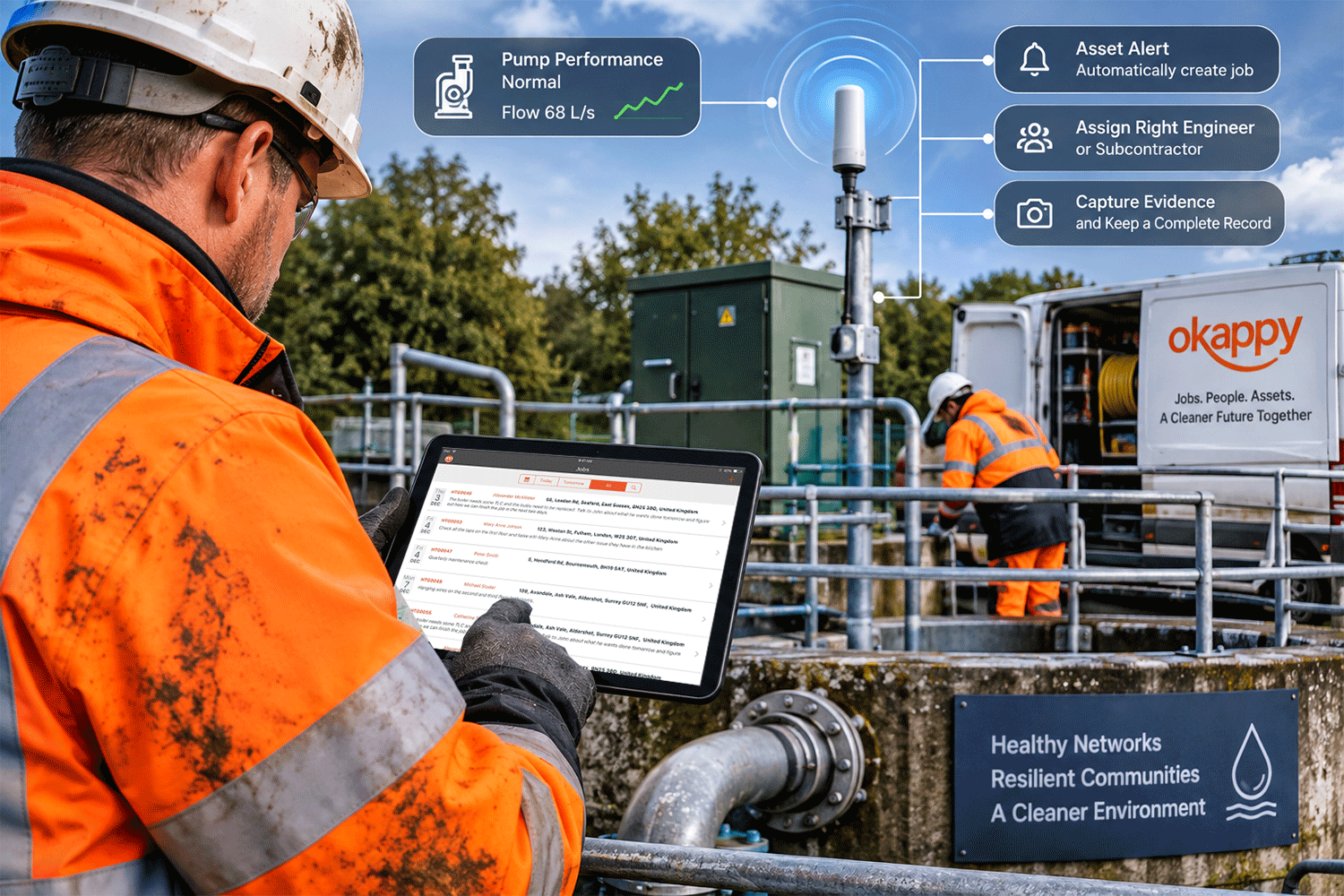
Platforms such as Okappy can connect customers, office teams, engineers and subcontractors so that jobs, status updates, forms, photographs and other information remain connected throughout the workflow.
As regulatory scrutiny increases, that connected record becomes more than an efficiency tool.
It becomes evidence of how the organisation operates.
From job management to operational assurance
AMP8 is creating enormous opportunities across the drainage and wastewater supply chain, but increased investment will come with increased expectations.
Customers and regulators want greater visibility, faster responses and better evidence.
The organisations best positioned to benefit will therefore not simply be those capable of completing more jobs.
They will be those capable of demonstrating, consistently and at scale, that the right work was identified, assigned, completed and recorded.
In an industry where failures can result in flooded properties, environmental damage and increasingly significant regulatory consequences, the audit trail is becoming almost as important as the job itself.