A pump stops working, an inspection identifies a problem, an engineer recommends further work or a monitoring system generates an alert. None of these events necessarily represents a major incident on its own. The danger is what happens when the information isn’t acted upon.
That issue came into sharp focus this week when Southern Water was fined £2.4 million following a series of pollution incidents in Kent. The incidents occurred between 2019 and 2021 and included untreated sewage entering waterways, a diesel leak from a generator and failures at wastewater pumping and treatment facilities.
In one incident, pumps stopped working at a treatment station and untreated sewage was discharged into Faversham Creek over three days. In another, investigators found around 70 dead fish, including eels, after untreated sewage entered Swalecliffe Brook from a wastewater pumping station.
For organisations operating drainage and wastewater infrastructure, however, one comment from the Environment Agency is particularly significant. It said the pollution could have been avoided if operations had been managed better and that the company didn’t have the checks in place to deal with problems.
That raises an important question for any large field-service organisation: how do you make sure the right things actually happen?
The problem isn’t always a lack of information
Modern drainage organisations generate enormous amounts of information. There are jobs, inspections, engineer notes, photographs, CCTV surveys, asset records, emails, alarms, customer requests, recommendations and subcontractor updates. Increasingly, there is also real-time information coming directly from assets.
The challenge can therefore be less about obtaining information and more about identifying which information requires action. An engineer might complete 20 inspections without finding anything significant, while the twenty-first identifies a deteriorating pump. That is the job an operations manager needs to know about.
Similarly, hundreds of jobs may be progressing normally while one hasn’t been accepted by the subcontractor, another engineer hasn’t arrived within the SLA, an inspection has recommended urgent follow-up work or a pumping station has generated its third call-out in a month.
Those exceptions matter.
Large organisations can’t manage every job manually
This problem becomes more acute as an organisation grows. If you run ten engineers, an experienced operations manager may have a good understanding of almost every job. Scale that operation to hundreds of engineers, multiple depots, national contracts and a network of subcontractors and that approach stops working.
Managers cannot personally check every job, nor should they need to. Instead, larger organisations need to manage by exception.
The operational system should highlight the critical jobs that haven’t been allocated, inspections that have identified defects, recommendations that haven’t generated follow-up work, jobs approaching their SLA, subcontractors that haven’t responded and assets that are repeatedly failing.
The objective isn’t to give managers more data. It is to give them the right information at the right time.
Inspections only create value when findings become actions
Recent Environment Agency figures illustrate the scale involved. The regulator says it carried out around 700 inspections of Southern Water sites over the past year and identified approximately 400 improvements that needed to be made.
The same principle applies inside drainage businesses. Completing an inspection isn’t necessarily the end of a process. If the inspection identifies remedial work, somebody needs to make sure that work happens.
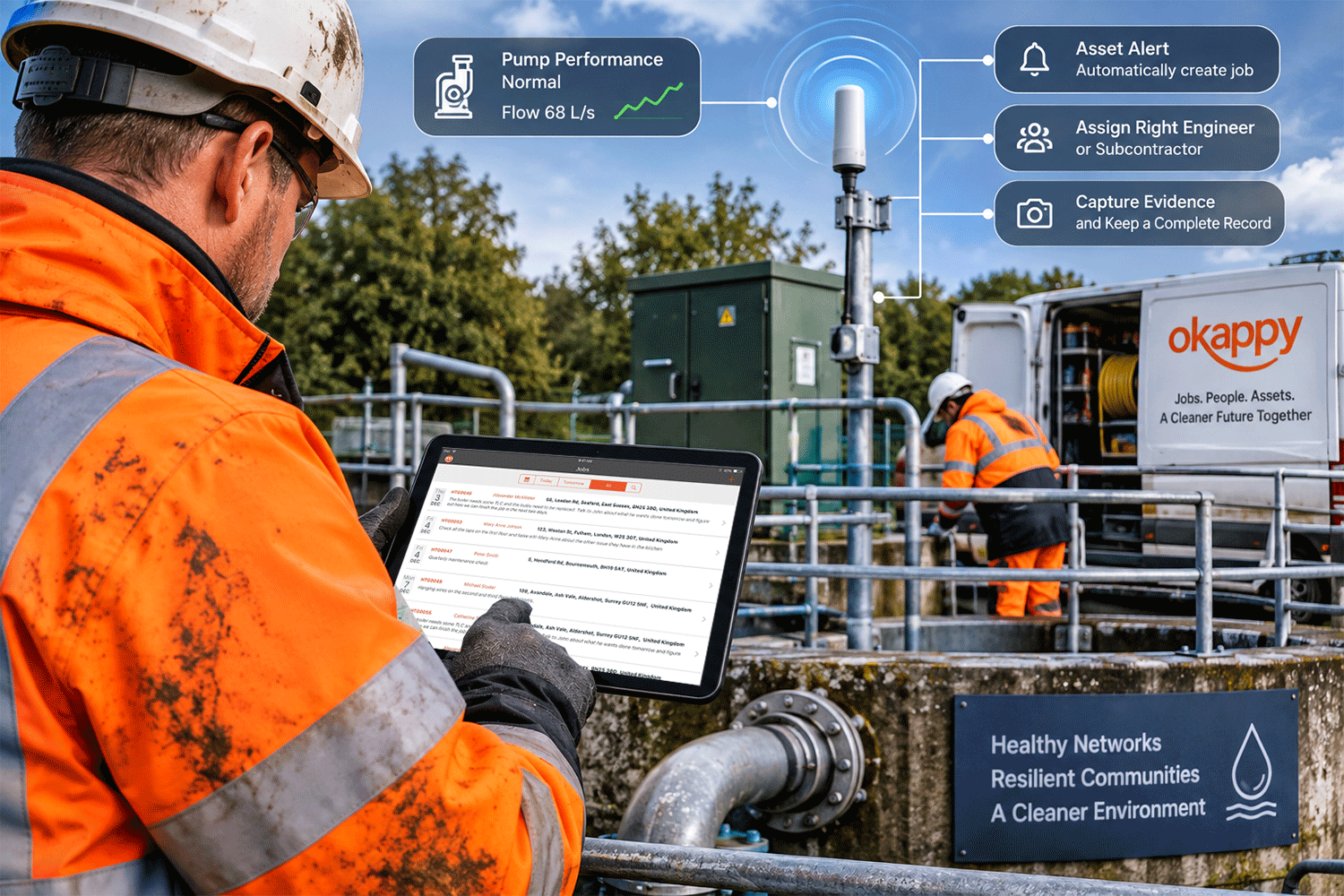
In a connected workflow, an engineer could complete an inspection on their mobile device. If everything passes, the job closes normally. If something fails, the result could automatically create a follow-up job, notify the appropriate manager or trigger an approval process.
The exception drives the next action. That is considerably more reliable than expecting somebody to read every completed job sheet and manually identify what needs to happen next.
AI makes exception management more powerful
Artificial intelligence potentially takes this further because much of the important information generated by field-service businesses is unstructured.
An engineer, for example, might write: “Pump running but bearing increasingly noisy. Recommend replacement before next service.”
To a traditional job-management system, that may simply be text stored against a completed job. An AI agent can potentially understand what it means, identify the recommendation, flag the potential risk and create a draft follow-up action.
The same principle can apply to incoming emails. A customer reports a blocked drain and AI identifies the site, interprets the requirement and prepares a job. A subcontractor sends an update indicating that additional equipment is required and, rather than the information disappearing into an inbox, it becomes part of the operational workflow.
The objective isn’t AI for its own sake. It is reducing the possibility that important information gets missed.
The water industry is moving towards connected information
This direction is reflected in another recent industry development. BIM4Water has published its 2026-2030 roadmap, setting out a strategy for digital transformation across the water sector.
One of its central themes is bringing together information from assets, sensors, control systems, maintenance activities and the wider supply chain. The aim is to turn those different data sources into actionable intelligence supporting proactive maintenance, risk management and long-term planning.
This is an important distinction. Water companies and their contractors don’t necessarily need another isolated system. They need their existing systems to communicate.
An asset-management platform might know what an asset is. A sensor might know how it is performing. A field-service platform knows who is attending. A contractor knows what work was completed. The real value appears when those pieces of information can be connected.
The supply chain needs to be part of the process
This is particularly important for larger drainage organisations because much of the physical work is delivered through supply chains. A water company may appoint a Tier 1 contractor, which might use several specialist drainage businesses. Those businesses may in turn use their own subcontractors.
If every organisation maintains a separate spreadsheet, inbox and job-management system, visibility quickly disappears and someone inevitably starts chasing updates by telephone or email.
Connected field-service management offers another approach. A job can move through the supply chain while status information flows back. The contractor responsible for the customer relationship can see that a job has been accepted, allocated, attended and completed without continually requesting updates.
More importantly, exceptions can become visible immediately. If a subcontractor hasn’t accepted an urgent job or an engineer hasn’t attended within the expected timeframe, the operations team can intervene before the issue becomes a larger problem.
AMP8 makes operational control even more important
The volume of work is also increasing. Costain has been selected to deliver around £150 million of upgrades across 15 Thames Water wastewater treatment sites as part of the Wastewater Asset Assurance Programme.
The work includes modernising inlet stations, improving storm-tank resilience and carrying out repairs and upgrades to wastewater systems. Thames Water says its wider programme involves improvements at more than 250 sites during AMP8.
Across the industry, programmes of this scale mean more projects, more contractors, more inspections and significantly more operational information. Simply adding people to administer that information isn’t scalable.
The challenge for larger organisations is therefore to increase the volume of work they can manage without increasing administrative overhead at the same rate.
From job management to operational assurance
This is where the role of field-service technology is changing. Originally, digitising field service often meant replacing the paper job sheet. For larger organisations, the requirement is now much broader.
It is increasingly about operational assurance.
Was the job received and allocated? Did the engineer attend? What did they find? Was evidence captured? Did they recommend further work? Was that recommendation acted upon? Did the subcontractor meet the SLA? Can the organisation demonstrate all of this six months later?
Okappy’s connected approach to field service is designed around this challenge. Customers, office teams, engineers and subcontractors can be connected around the job, allowing information to move through the operational chain rather than becoming fragmented across emails, spreadsheets and separate systems.
AI agents, automation and integrations can then increasingly help identify the exceptions that actually require human attention.
Would you know if something important was missed?
The lesson from the latest industry news isn’t simply that environmental failures can be expensive. It is that organisations need systems and processes capable of identifying problems before individual failures become significant incidents.
For an Operations Director, the useful question may therefore be:
If one important thing went wrong amongst the thousands of jobs, inspections, alerts and messages moving through our organisation today, how quickly would we know?
The best operational systems shouldn’t require managers to watch everything. They should make sure managers see the things that matter and give them the information needed to act.
As drainage operations become larger, more connected and increasingly data-driven, the ability to manage by exception could become one of the most important operational capabilities of all.