DEFRA’s digital waste tracking changes are being introduced as a regulatory requirement. But businesses shouldn’t look at them as just another regulation. They could be the catalyst for something much bigger.
From compliance to visibility
When information is recorded digitally, it becomes much easier to find, analyse and share. Instead of having waste information spread across paperwork, spreadsheets and separate systems, businesses can start building a connected record of what is happening across their operation. That can provide benefits beyond simply meeting a reporting requirement.
Better information
Digital records can make it easier to understand:
- What waste is being received
- Where it is being received
- When it arrived
- Who transported it
- What type of waste it was
- How much was received
- What documentation supports it
- Whether the receipt has been reported
The proposed Okappy approach would also retain submission information, corrections and audit history against the job.
Better accountability
A digital audit trail can provide a much clearer picture of who entered information, what was submitted and what was subsequently changed.That can be valuable when customers, managers or regulators need to understand what happened.
Better management
Once information is digital, businesses can start asking better questions.
- Where are the delays?
- Which receipts are generating errors?
- Which sites are busiest?
- Which information is most frequently missing?
- How much administrative time is being spent correcting data?
These aren’t questions that require DEFRA to ask them. They’re questions that can help businesses run better.
DEFRA is accelerating the move
DEFRA itself says that digital waste tracking is intended not only to improve regulation and tackle waste crime, but also to improve access to data and reduce some of the inefficiencies associated with fragmented waste information. (Legislation.gov.uk)
And its approach recognises that existing software can play an important role.
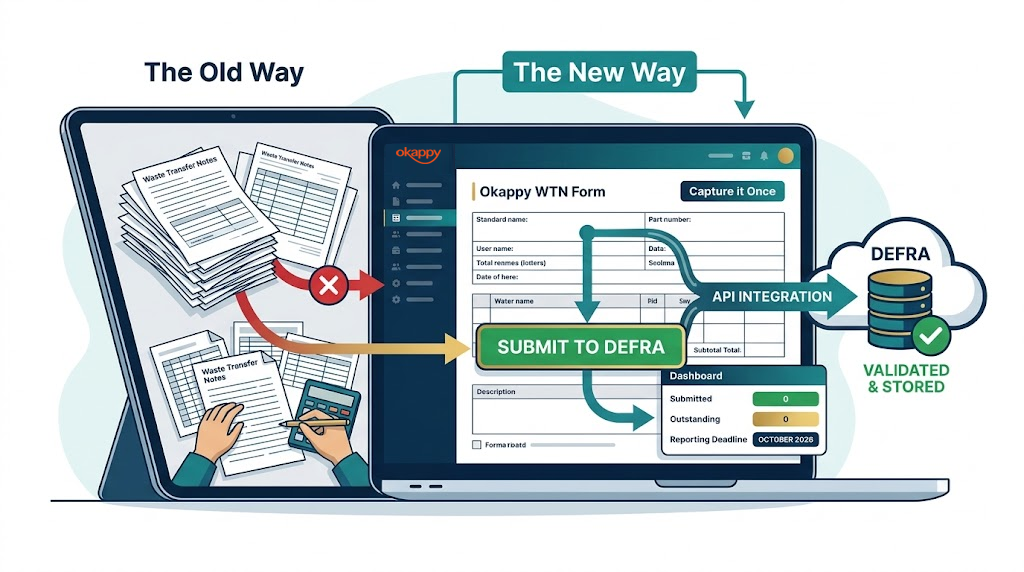
The government has specifically designed the service around API integration so businesses can connect their own software rather than manually recreating every waste movement. (GOV.UK)
That’s why we’re preparing now
At Okappy, we believe the best way to approach regulatory change is not to wait until the last minute. We’re working on a proposed DEFRA integration that builds on the systems our customers already use:
- Jobs.
- Waste Transfer Notes.
- Checksheets.
- Attachments.
- Mobile workflows.
- Customer and site records.
The aim is to bring DEFRA reporting into that existing workflow rather than creating another disconnected system.
We’re preparing for it now
DEFRA requires software providers to integrate with its API and pass production approval tests before their software meets the relevant digital waste tracking requirements. (GOV.UK). We’re actively working with Defra to ensure we’re ahead of the curve.
We’re designing, developing and testing the functionality now, so that when digital waste reporting becomes mandatory, our customers aren’t starting from scratch.
The real opportunity
The question businesses should be asking isn’t simply “How do we comply with DEFRA?”. It’s “How can we use digitalisation to make our business better?”
The regulatory change is coming. The opportunity is to make sure your business is ready to take advantage of it.
Okappy is working towards making that transition as simple, connected and practical as possible.