The UK water industry is entering a period where demonstrating operational performance is becoming just as important as delivering the work itself. With billions of pounds being invested in wastewater infrastructure, increasing regulatory scrutiny and growing pressure to improve environmental outcomes, water companies and their contractors face a significant challenge.
It is no longer enough to demonstrate that engineers attended a site or that maintenance work was completed. Increasingly, organisations need to show that the work delivered the intended result, that problems were identified and addressed, and that reliable evidence exists to support their performance.
Three developments in the water industry this week highlight why this matters and what it could mean for larger drainage contractors and their supply chains.
£240 million in performance-related adjustments
On 14 October, Ofwat published its draft Outcome Delivery Incentive (ODI) determinations for 2025-26, proposing a net £240 million reduction in customer bills, including £107 million to be returned through bills in 2027-28.
These adjustments reflect how water companies have performed against regulatory commitments covering areas such as leakage, customer service and environmental performance. Companies that exceed their targets can receive financial rewards, while those that fall short face penalties.
The proposed adjustments are not yet final, with Ofwat expected to publish its final determinations in December.
Nevertheless, the announcement reinforces an important principle: investment and activity alone are not sufficient. Water companies must demonstrate measurable improvements in performance.
For drainage contractors working with utilities, this has significant implications. Although Ofwat’s financial incentives apply directly to regulated water companies rather than their suppliers, contractors play an important role in delivering the operational improvements on which those companies are assessed.
As a result, the ability to demonstrate consistent performance could become increasingly valuable when competing for major contracts.
The importance of operational control
Two further announcements this week illustrate why reliable operational processes are essential.
On 16 October, Ofwat announced that Hafren Dyfrdwy had breached its legal obligations relating to the operation of its wastewater treatment works and sewer network.
The regulator identified shortcomings in the company’s management of wastewater infrastructure, including failures to maintain adequate processes for monitoring asset performance and identifying compliance risks.
A proposed £280,000 enforcement package includes improvements to stormwater infrastructure and environmental initiatives, subject to consultation.
Separately, the Environment Agency announced that Anglian Water had been fined £1.6 million following sewage pollution affecting the River Brain in Essex.
The incidents occurred in 2022, with investigators identifying failures involving a faulty valve, alarms that were not acted upon and inadequate communication between staff.
While these cases involve different circumstances, they demonstrate the importance of effective operational management.
Having monitoring systems, maintenance procedures and inspection programmes is not enough if the information they generate does not result in appropriate action.
For larger organisations, the challenge is ensuring that operational processes work consistently across multiple sites, teams and contractors.
Moving beyond the completed job sheet
Traditional field-service management has largely focused on recording work. An engineer receives a job, attends the site, completes the necessary tasks and submits a job sheet.
For many organisations, that remains the foundation of their operations. However, larger customers increasingly require more detailed information about service delivery.
Consider a drainage contractor responsible for maintaining pumping stations across several hundred commercial and industrial sites.
Completing a planned maintenance visit is important, but the customer may also want to know whether the asset was operating correctly, whether any defects were identified, whether remedial work was recommended and whether those recommendations were subsequently addressed.
A completed job sheet provides evidence of attendance. A connected operational record can provide evidence of the entire process.
This distinction becomes particularly important when managing long-term maintenance contracts, regulatory obligations and service-level agreements.
Managing performance across the supply chain
Large drainage organisations rarely deliver every job using their own employees. National contracts often depend on regional subcontractors, specialist engineers and external service providers.
This creates additional complexity because information must move between different organisations.
A facilities management company might appoint a national drainage contractor to manage services across hundreds of properties. That contractor may then allocate individual jobs to regional specialists.
The customer expects consistent service regardless of which organisation undertakes the work.
However, if each business operates independently, obtaining accurate information can become difficult. Jobs may be allocated through one system, updates provided by email and completion reports submitted separately.
This creates administrative overhead and makes it harder to identify delays, monitor service levels or investigate problems.
Connected field-service management offers a different approach by allowing organisations to collaborate around the same operational workflow.
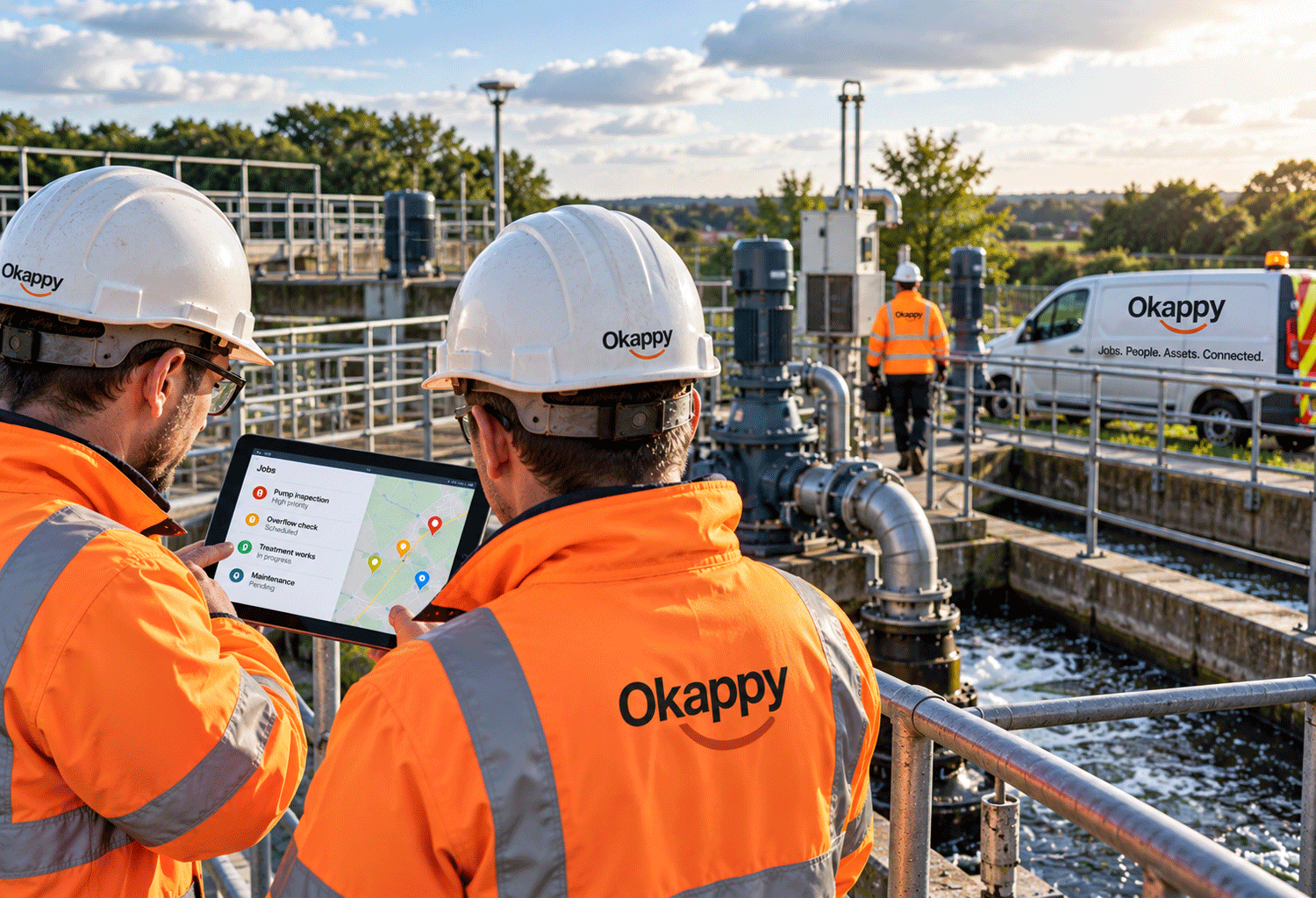
With Okappy, customers, contractors and subcontractors can be connected through a network that enables jobs and updates to move between organisations.
Rather than repeatedly chasing subcontractors for information, managers can maintain visibility of job progress and identify where intervention may be required.
Turning operational data into meaningful performance information
For larger contractors, one of the biggest opportunities lies in making better use of the information already being collected.
Most organisations have substantial amounts of operational data, including job completion times, engineer attendance records, inspection results, photographs, customer communications and subcontractor updates.
The challenge is turning this information into something useful.
For example, an Operations Director might want to understand why a particular region consistently takes longer to complete reactive drainage jobs, why certain assets generate repeated call-outs or which subcontractors are struggling to meet agreed service levels.
These questions cannot always be answered by looking at individual job sheets.
They require information to be structured, connected and available for analysis.
The objective should be to move from simply reporting how many jobs were completed to understanding how effectively the organisation is performing.
This also creates opportunities for continuous improvement. Recurring problems can be identified, resources allocated more effectively and preventative maintenance programmes adjusted based on actual operational experience.
How AI could change operational reporting
Artificial intelligence offers further opportunities to improve how drainage organisations manage performance.
Much of the information collected during field-service operations is unstructured. Engineers write notes, customers send emails, subcontractors provide updates and inspection reports contain recommendations.
Traditionally, extracting meaningful information from these records has required considerable manual effort.
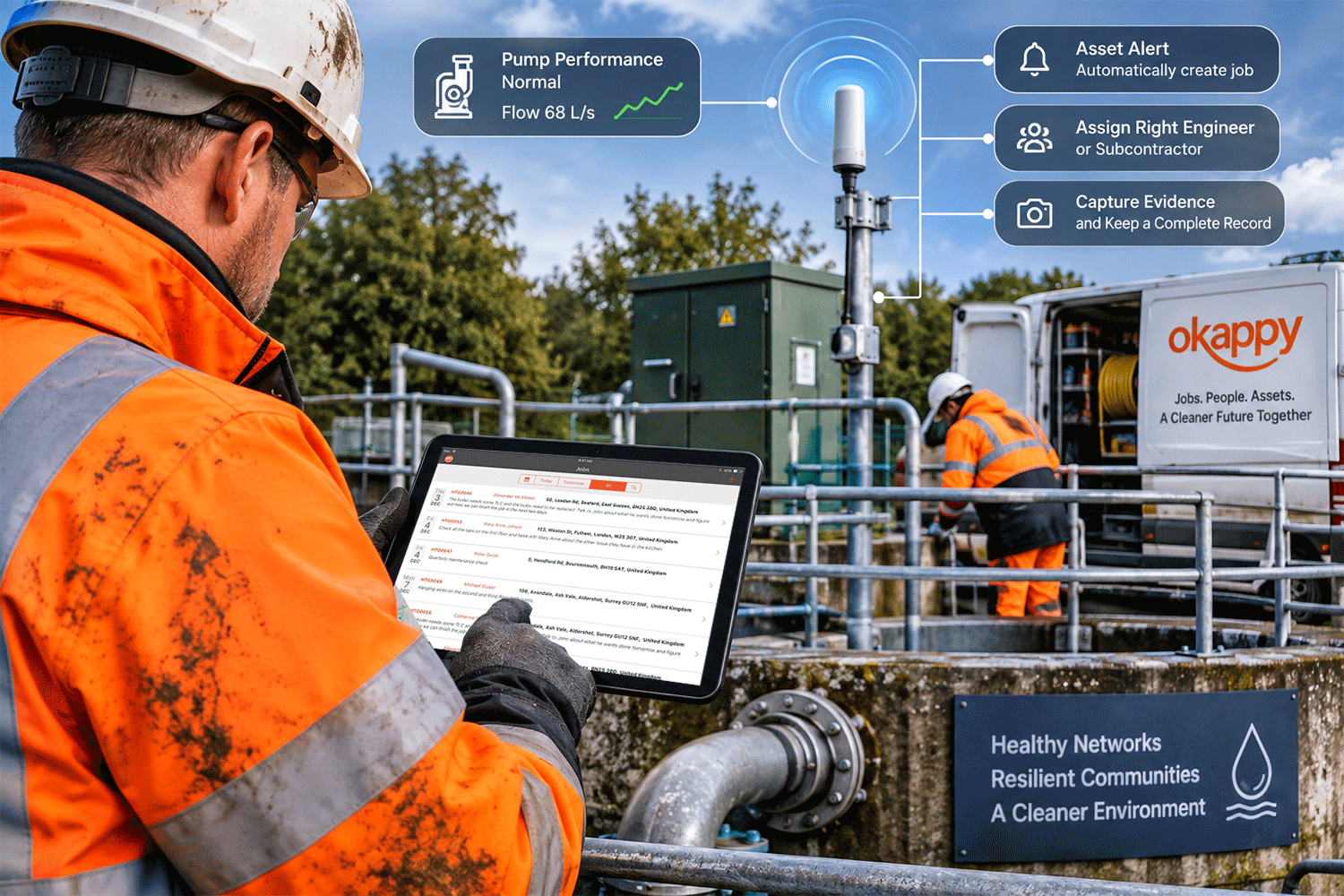
AI agents can potentially analyse job descriptions, identify recurring problems, highlight recommendations and help managers understand what is happening across their operations.
For example, a manager could ask which pumping stations have experienced repeated failures during the previous six months or which completed inspections identified outstanding remedial work.
Rather than manually reviewing hundreds of records, an AI-enabled system could help retrieve and summarise the relevant information.
Okappy is developing AI capabilities to support activities such as creating jobs from incoming communications, querying operational information and assisting with scheduling and documentation.
The important distinction is that AI needs reliable underlying data and structured operational processes to be effective.
Without those foundations, even sophisticated AI tools will struggle to provide dependable answers.
A competitive advantage for larger drainage contractors
The implications of these developments extend beyond regulatory compliance.
Water companies and major facilities management organisations are under pressure to improve efficiency, demonstrate value and maintain better control over their supply chains.
Contractors that can provide reliable operational information may therefore have an advantage when competing for larger contracts.
A national drainage business that can demonstrate consistent service levels, transparent subcontractor management, comprehensive inspection records and effective follow-up procedures offers more than simply the ability to complete jobs.
It provides customers with greater confidence in the management of their assets and infrastructure.
Importantly, this does not necessarily require replacing every existing system. Connecting operational workflows and improving the quality of information exchanged between organisations can deliver significant benefits.
From activity to accountability
The latest developments in the water industry reinforce a broader change in expectations.
Regulators are increasingly focused on measurable outcomes, while customers want greater transparency over the services they receive.
For drainage contractors, this creates both challenges and opportunities.
Organisations need to maintain accurate records, manage complex supply chains and demonstrate that operational processes are being followed. At the same time, technology is making it easier to connect teams, automate administration and extract useful information from everyday activities.
The question for larger drainage organisations is no longer simply how many jobs they can complete, but how effectively they can demonstrate the quality, consistency and outcomes of the work they deliver.
Those that can provide this level of operational visibility will be better positioned to build stronger customer relationships, improve efficiency and compete for the next generation of major infrastructure and maintenance contracts.