For much of the last year, the water industry’s AMP8 programme has been discussed in terms of future opportunity.
That opportunity is increasingly becoming real work.
Recent weeks have seen a succession of major contract awards covering wastewater treatment, sewer networks, resilience and environmental improvements. For drainage contractors and specialist suppliers, this marks an important transition from AMP8 planning to delivery.
But winning additional work creates another challenge.
Can your operation scale without adding the same proportion of people, administration and complexity?
For larger drainage organisations, that may become one of the defining questions of AMP8.
Major contracts are flowing through the supply chain
The scale of current activity is significant.
Anglian Water has selected two joint ventures for a £1.5 billion Major Projects Framework covering major water and wastewater schemes through AMP8 and potentially beyond. The selected joint ventures include Ferrovial Construction with MWH Treatment, and VolkerFitzpatrick with VolkerStevin Infrastructure.
Meanwhile, Thames Water has awarded Costain around £150 million of work upgrading 15 wastewater treatment sites across the Thames Valley. The programme includes inlet station upgrades, improvements to storm tank resilience and repairs and modifications to existing treatment assets.
Thames Water has also awarded Galliford Try a £47.5 million contract to deliver the Camberley Sewage Treatment Works Flow Compliance project, a scheme designed to improve performance, resilience and environmental compliance.
These are not isolated announcements. They are signals that AMP8 is now becoming operational work that needs to be planned, scheduled, delivered, evidenced and invoiced.
More investment means more delivery pressure
The wider funding environment is also moving quickly.
On 13 August, Ofwat provisionally approved £3.4 billion of additional expenditure for water companies to improve infrastructure, support growth and improve environmental outcomes. That comes on top of the existing AMP8 programme, which the government has described as a £104 billion investment programme for the water sector between 2025 and 2030.
For contractors, this creates a substantial commercial opportunity. But it also raises expectations. Water companies, infrastructure clients, housing providers and facilities management organisations will not simply want jobs completed. They will want confidence that work has been completed correctly, on time, to specification and with a clear audit trail.
That matters because many larger drainage businesses still carry hidden operational friction inside their day-to-day processes.
The scaling problem is often administrative
When workload increases, the obvious response is to recruit more engineers, hire more coordinators and add more subcontractors.
Sometimes that is necessary.
But if the underlying operational process is fragmented, every new contract can also add more duplicated administration.
- More customer emails to interpret
- More jobs to create manually
- More site evidence to chase
- More subcontractor updates to reconcile
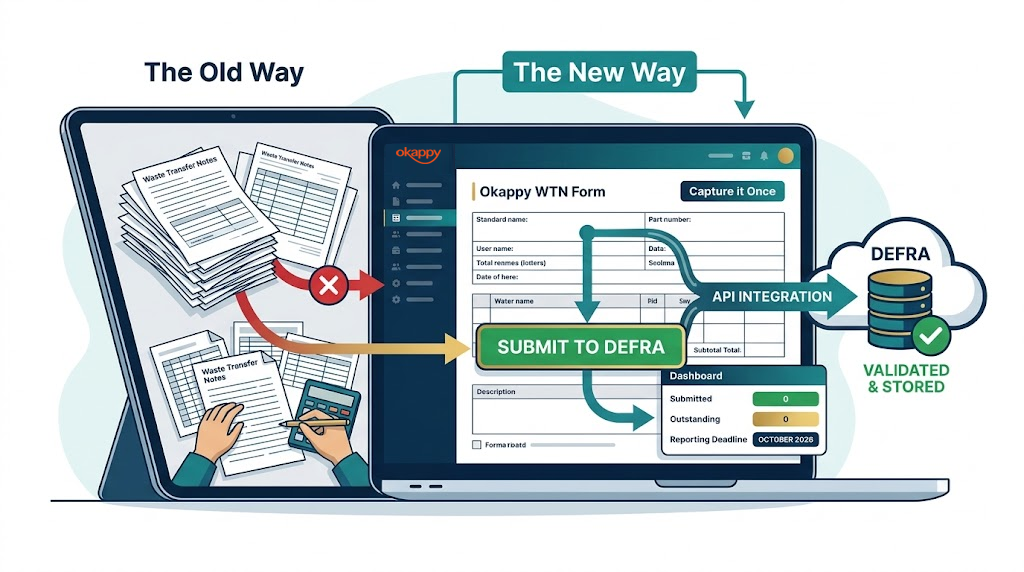
- More compliance documents to file
- More invoices to prepare
- More exceptions for managers to investigate
At small volumes, these tasks can feel manageable. At AMP8 scale, they become a drag on productivity.
The issue is not usually one major failure. It is hundreds of small manual steps repeated across thousands of jobs, regions, operatives and subcontractors.
Customers will expect stronger evidence
Drainage and wastewater work is increasingly connected to environmental performance, regulatory scrutiny and public confidence.
That changes what customers expect from their supply chain.
A completed job note may no longer be enough. Customers may require photographs, timestamps, asset references, engineer notes, risk assessments, inspection forms, customer signatures, waste information and proof that the correct process was followed.
For larger organisations, this evidence needs to be captured as part of the job workflow, not assembled afterwards from separate inboxes, spreadsheets and paper forms.
If a client asks what happened on a job six months ago, the answer should be available quickly. Who attended? When did they arrive? What did they find? What evidence was captured? Was follow-up work required? Was it raised? Was it completed?
The faster a business can answer those questions, the more credible it becomes as a delivery partner.
Subcontractor networks need to be connected
Many drainage organisations rely on subcontractors to provide national coverage, specialist equipment or additional capacity during busy periods.
That flexibility is valuable, but it can create visibility gaps.
A job may move from customer to main contractor, from the main contractor to a regional team, and then to a subcontractor. Updates may then travel back through the same chain. Each handover creates an opportunity for information to be delayed, duplicated or lost.
As AMP8 work increases, that model becomes harder to control using email and spreadsheets alone.
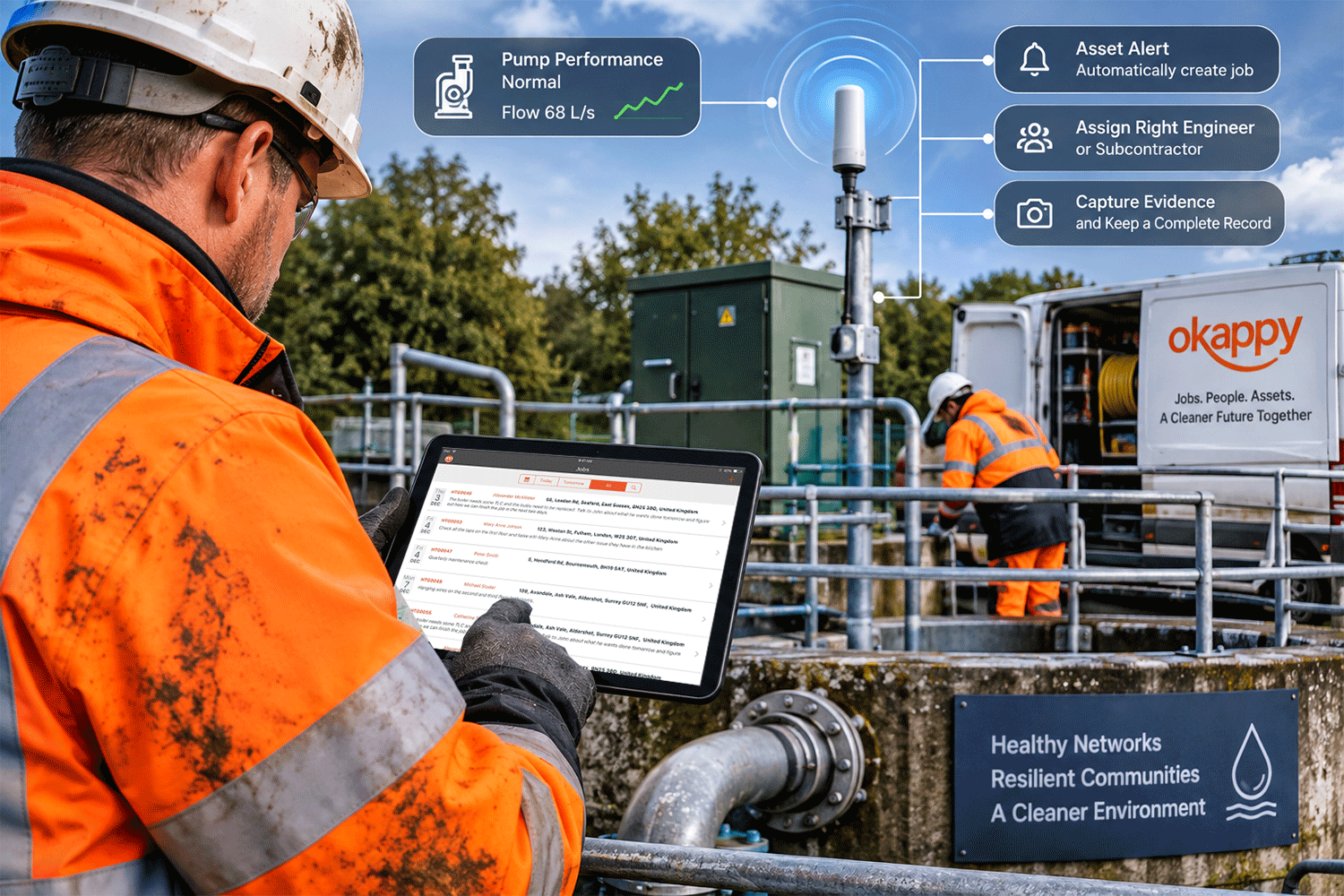
Connected job management gives all parties a clearer operational record. Jobs can be issued electronically, updates can be captured from the field, forms and photographs can be attached to the job, and office teams can see progress without chasing every update manually.
For main contractors, that improves control. For subcontractors, it reduces ambiguity. For customers, it creates better visibility.
AI can help, but only if the workflow is connected
AI is already beginning to influence field service operations, but the most useful applications are often practical rather than dramatic.
For drainage businesses, AI can help interpret incoming job requests, identify missing information, summarise job histories, prepare draft invoices, highlight exceptions and support operational teams with repetitive administrative work.
But AI works best when the underlying data is connected.
If job information is scattered across emails, spreadsheets, forms, subcontractor portals and accounting systems, automation becomes harder and less reliable.
The first step is therefore not replacing people. It is creating cleaner operational workflows so that people, systems and customers are working from the same record.
What larger drainage businesses should be asking
For Operations Directors, Contract Managers and senior leaders, AMP8 creates a useful moment to review whether current systems can handle the work that is coming.
Useful questions include:
- How quickly can new work be received, reviewed and assigned?
- Can managers see job status across regions in real time?
- Can subcontractors update jobs without relying on email chains?
- Are forms, photographs and compliance records attached to the job?
- Can invoices be prepared quickly from completed work?
- Can the business prove what happened on a job without chasing multiple people?
If the answer to any of those questions is uncertain, growth may expose the weakness.
From opportunity to operational readiness
AMP8 is no longer just a future funding programme. Contract awards are moving through the supply chain and major wastewater schemes are entering delivery.
For drainage contractors, this is good news. Demand for inspection, maintenance, rehabilitation, emergency response and environmental compliance work is likely to remain strong.
But the organisations best positioned to benefit will be those that can scale without losing control.
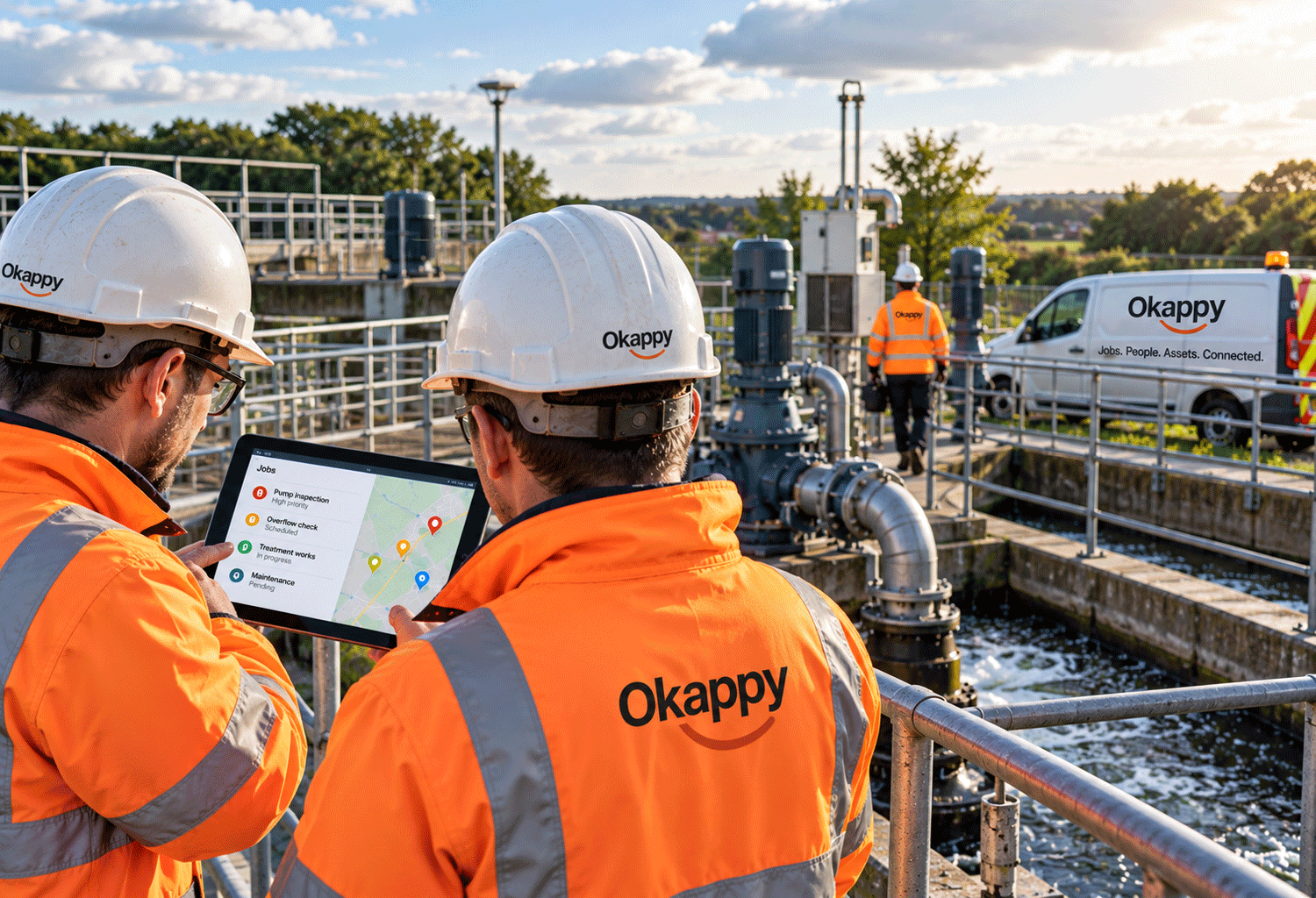
Platforms such as Okappy help connect customers, office teams, engineers and subcontractors so that work can be managed from request through to completion, evidence capture and invoicing.
As AMP8 moves into delivery, operational visibility is becoming more than an efficiency improvement.
It is becoming a requirement for growth.
See your field-service reports in a demo
Talk to our success team and tell us what’s holding you back with your workforce management.
Demos take 30 minutes or less.