For many businesses, paper and spreadsheets have worked perfectly well for years.
So why change?
The answer is that the way waste information needs to be managed is changing.
From October 2026, permitted and licensed waste receiving sites in England and Wales will need to report waste digitally, according to DEFRA’s digital waste tracking timetable.
DEFRA does provide a spreadsheet-based option, but it has also made clear that its preferred approach is to integrate the digital waste tracking service with existing software through an API. DEFRA describes the spreadsheet as a temporary solution for businesses that don’t yet have suitable software.
That makes this a good time to consider the different approaches.
Option 1: Paper
Paper is familiar.
It can also be quick and convenient at the point of work.
But once information is written down, someone usually has to do something with it.
It may need to be:
- Filed
- Re-entered
- Checked
- Scanned
- Emailed
- Transferred into another system
Every additional step adds administration.
Option 2: Spreadsheets
Spreadsheets are a step forward.
They’re searchable, shareable and can help businesses organise information.
But they still rely heavily on people entering and maintaining the data.
And when a business has multiple sites, customers, vehicles or waste movements, spreadsheets can quickly become complicated.
There’s also the question of what happens when information changes.
How do you know which version is correct? Who has updated it? Has the change been submitted?
Option 3: Connected software
This is where digital waste management becomes much more interesting.
Instead of treating DEFRA reporting as a separate activity, software can potentially make it part of the workflow businesses already use.
DEFRA’s own approach recognises this. Its guidance says businesses can use software that connects directly to the Report Receipt of Waste API to upload waste receipt reports.
The real benefit: capture information once
Imagine a waste receipt being recorded in your normal workflow.
The information is captured. The system checks it. The information is submitted. The response is stored. If there’s an issue, the user knows what needs correcting.
That’s very different from:
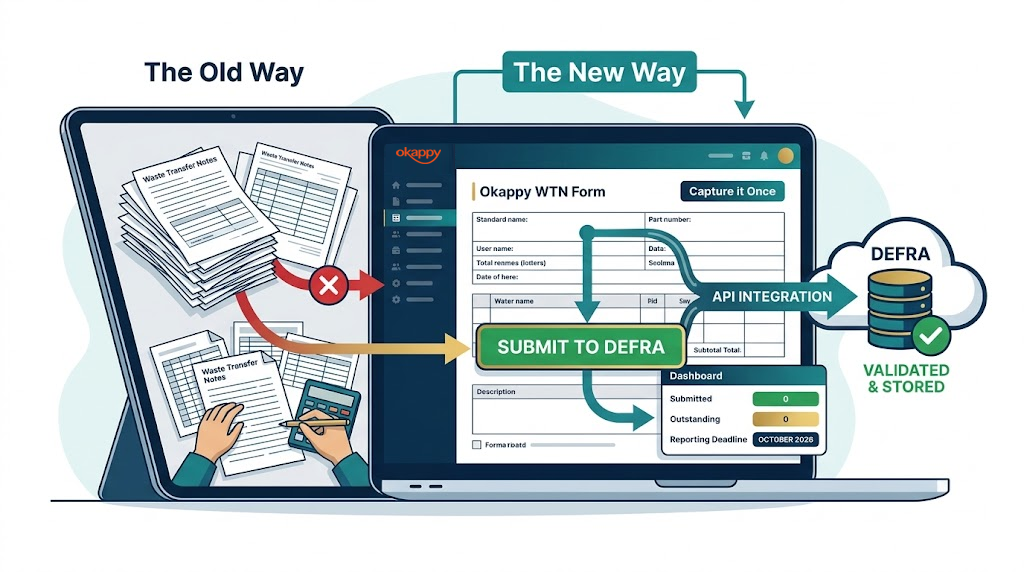
Paper → spreadsheet → checking → re-entering → submitting → filing
That’s the direction Okappy is taking
Okappy is developing a proposed DEFRA reporting workflow around its existing job management functionality.
The current design would allow businesses to capture receipt information within an Okappy job or Waste Transfer Note, validate the information and submit it through the DEFRA API.
The proposed system would also retain the DEFRA response, including the Waste Tracking ID, and show whether a submission was successful, failed or generated warnings.
We haven’t received DEFRA approval yet, so this functionality should be viewed as development in progress rather than an approved solution.
But that’s precisely why we’re working on it now.
Getting ahead rather than catching up
Regulatory deadlines have a habit of arriving quickly.
Businesses that start preparing now have time to test their processes, identify gaps and make changes before digital reporting becomes mandatory.
The question isn’t simply:
How will we comply with DEFRA?
It should be:
How can we make the move to digital reporting work for our business?